Tuesday, July 21, 2009

Meatballs with Rice in Tomato Sauce

Meatballs with Rice in Tomato SauceTomato sauce was my grandfather-in-law’s favorite. He loved tomato sauce with a lot of extra virgin olive oil and black pepper. Whenever I make tomato sauce, I think of him with high regard, a person I have never met and have known only through my husband’s descriptions.

My grandfather-in-law was born in northern Greece when it was still under the Ottoman Empire’s occupation. Including his native language, Greek, he fluently spoke, wrote and read English, French, Slavic and Turkish, and he was able to read and understand Ancient Greek, Latin, and Arabic. While none of the people in his village hold a high school degree, he earned a college degree in Education. Later he became an elementary school teacher. He was excessively simple, honest and faithful for his entire life.

This simple man loved gardening, the “Les Misérables” by the famous French author Victor Hugo, and tomato sauce. Because of the Ottoman influence on the cuisine in his region, he especially loved spicy tomato sauce.

I usually cook meatballs with rice in spicy tomato sauce, which became our family’s standard. Certainly, a lot of extra virgin olive oil and black pepper are essential. I enjoy this dish under the blue sky indulging myself in imagination of my grandfather-in-law’s humble life.

Ingredients:
3 potatoes
3 cups finely chopped tomatoes
2 tbsp tomato paste
Salt and freshly ground black pepper
Water

Meatballs (about 40 meatballs):
1 lb ground beef
1 finely chopped onion
2 cloves of garlic
¼ cup finely chopped mint
1 egg
½ cup rice
1 teaspoon salt
Freshly ground black pepper
1 teaspoon cumin
½ cup all-purpose flour

Directions:
1. Place all of the ingredients except the all-purpose flour for meatballs in a large bowl. Mix them well.
2. Break off pieces of the mixture and make very small meatballs (the size of walnuts). Coat the meatballs with the all-purpose flour.
3. Peal the skins of the potatoes and chop them small squares.
4. Heat the olive oil in a fry pan and fry the chopped potatoes for around 5 minutes. Add the tomatoes and tomato paste and stir them well.
5. Add 2 to 3 cups of water and bring to a boil. Add the meatballs one by one. Add more water if all of the meatballs are not covered by water.
6. Season with salt. Simmer and stir time to time for about 30-40 minutes.
7. Serve them hot!

Saturday, July 18, 2009

Sweet Kidney Beans

I do not remember the name of the fresh beans I purchased from a farmer at the local farmer’s market. But I am sure this is a kind of kidney beans. They are two to three times bigger than regular red kidney beans, which are frequently used in Cajun/Creole cuisine in Louisiana.

First, I cooked a Cajun bean soup using these beans. It was very good. However, when I tasted them, I immediately felt they might also be good for sweet beans.

Usually, Japanese black beans are used for this dish. These simmered sweet beans are considered a special dish and typically are served in the New Year’s Day. I love these black sweet beans since I was a kid. Therefore, my mother cooked this dish for a few times a year.

My instinct was correct. These particular kidney beans went very well with the sugar and soy sauce. They can be served as a great appetizer or nice cold dessert.

Ingredients:
1 and ½ cups fresh or dried kidney beans
½ cup sugar
2 tablespoons of soy sauce

Directions:
1. If you use dried kidney beans, soak them in water overnight.
2. Wash the beans well. Put them in a large pot and water until all of the beans are covered by water.
3. Bring to a boil. Then discard the water. In order to remove the harshness of the beans, repeat this process for two to three times.
4. After step 3 is done, add water until all of the beans are covered by water. Also add the sugar and soy sauce. Bring to a boil. After boiling, lower the heat. Simmer for one hour to one and half hours until the beans become very soft.
5. Refrigerate the simmered sweet beans and serve them cold!

Thursday, July 16, 2009

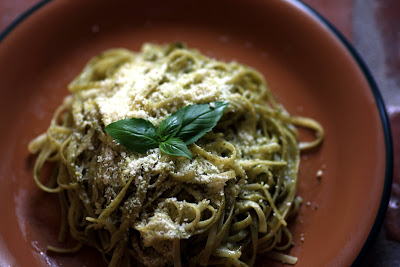
Linguine in Pesto Sauce

Linguine in Pesto Sauce
Basil, whose name comes from the Greek word for “king,” is one of the most essential herbs in Mediterranean cousin. However, the origin of this herb is none of the Mediterranean countries. According to Wikipedia, “Basil is originally native to Iran, India and other tropical regions of Asia, having been cultivated there for more than 5,000 years.” No wonder that this herb is used in many dishes from India, Thai and Vietnamese cousins.
In fact, basil was brought by Alexander the Great during his expedition to India.

Recently, there are many kinds of basil seeds and plants available in stores. Yet, my most favorite basil is sweet and aromatic Genovese basil from Genoa region in Italy. This basil reminds me of summer and this simple, yet, delicious pesto sauce.

Pesto is not only tasty but also very healthy food. Basil is high in vitamin K, which helps a body absorb calcium and other beneficial minerals to improve the bones. Parmesan and Romano cheese are excellent sources of calcium. In addition, pine nuts are rich in Vitamin B1 and B3.

Since my basil pants are big enough to be harvested, I decided to make lots of pesto sauce. It can be tossed with pasta or used as spread on crispy bread. Also pesto goes well with meat and fish. It can be stored in a refrigerator up to a several days.

BasilIngredients (4-5 Servings):
3 bunch of fresh basil leaves
1/3 cup pine nuts
½ grated Parmesan or Romano cheese
3 cloves of garlic
A pinch of salt
½ cup extra virgin olive oil
1 lb linguine

Directions:
1. Wash the basil leaves and drain them well.
2. Add all of the ingredients in the blender or food processor to grind them until they become creamy.
3. Boil water in a large pot and cook the linguine for 8 to 10 minutes or al dente.

4. Toss and mix the linguine with the pesto sauce. Serve with a piece of crispy bread!

Sunday, July 12, 2009

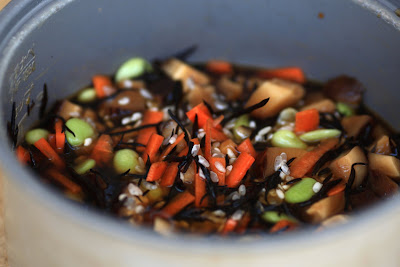
Steamed Rice with Hijiki Seaweed (Hijiki Gohan)

Steamed Rice with Hijiki SeaweedWhen I came to New York City for the first time in the early 90’s, eating healthy Asian food was already a boom among yuppies. I found out numbers of trendy restaurants serving seaweed, including hijiki, and other exotic Asian foods. However, I had noticed that many chefs were still learning and experimenting on how to cook using such ingredients. I realized that when I tried some tasteless hijiki because it had not been soaked or spiced enough by the chef. This happened in one of the most stylish restaurants in New York City.

Lately, not only professional chefs but also many regular people are already familiar with these Asian vegetables and food items. When I discovered a delicious hijiki salad, which was prepared by a non-Asian and non-professional cook, in a potluck party in New York City, I was amazed and pleased at that same time.

Hijiki is a kind of seaweed and it is an ultra nutritious food item. It is very rich in calcium. Actually, it contains 10 times more calcium than whole milk. Also, it is an excellent source for iron. It has 5 times more iron than chicken livers. In addition, it is high in dietary fiber.

Using a rice cooker, this dish of steamed rice with hijiki seaweed is extremely easy and healthy. If you do not have a rice cooker, use a large pot and cook and steam the rice along with the other ingredients. This dish also contributes a nice color opportunity to your table.
Shiitake MushroomsIngredients (4 servings):
2 cups rice
1 carrot
2 tablespoons of hijiki (seaweed)
¼ cup of fresh/frozen soybeans (or fresh/frozen baby lima beans)
2-4 dried/fresh shiitake mushrooms
2 tablespoons of soy sauce
1 tablespoon of mirin (rice wine without alcohol)
1 tablespoon of sake (famous Japanese rice wine)A pinch of sugar

Chopped CarrotDirections:
1. Wash the rice and put it in the rice cooker. Add 1½ cups of water.
2. Soak the hijiki seaweed in cold water for about 30 minutes (or follow the instructions on the hijiki package). Drain it well.
3. If you use dried shiitake mushrooms, soak them in cold water for about 30 minutes (or follow the instructions on their package). Drain them well. Cut off their stems. Chop them into small cubes.
4. Chop the carrot into small pieces.
The mixture5. If frozen soybeans or frozen baby lima beans are to be used, defrost them.
6. Put the chopped carrot, soaked hijiki seaweed, the beans, the chopped shiitake mushrooms, soy sauce, mirin, sake and sugar in the rice cooker. Mix them well with the rice.
7. Cook them in a rice cooker or a large pot. Serve them hot!

Friday, July 10, 2009

Udon Salad

Udon SaladJuly 7th was tanabata, a star festival, in Japan. This seasonal festival originally came from China. It is a sad but lovely story behind this celebration.

Once upon a time, there was a beautiful lady, named Orihime, who was a daughter of the Empire of the Sky and an excellent cloth waver living on one side of the Milky Way. One day she met Hikoboshi, who was a hard-working cow keeper and lived on the other side of the Milky Way. They immediately fell in love with each other. Soon after their encounter, with the Empire’s permission, they happily wedded. However, soon after that they abandoned their working duties. Orihime stopped waving clothes and Hikoboshi let his cows free, which made the Empire extremely angered. Therefore, he separated them across the Milky Way. Yet, the Empire only permitted them to see each other once a year on July 7th. For that reason, you can see Orihime (Vega) and Hikoboshi (Altair) meet in the middle of the Milky Way once a year on the 7th of July. But, in general it is raining on that day, which makes the lovers’ rendezvous private. So you are not able to see the two stars approaching each other.

This was the story I have known throughout my childhood from my mother. I was a little astronomy geek when I was a kid. Therefore, I was enormously fascinated about these two bright stars, Vega and Altair, coming across each other. I remember that I stared at the sky for hours to try to locate this amazing phenomenon once a year. However, of course, it never saw it myself. Plus, unfortunately it was very difficult to see any stars in the light polluted Japanese urban sky. Soon enough, I realized that it was just one of the many mythologies, which disappointed me very much.

July 7th of this year, I prepared this udon salad dish to celebrate this star festival. I used udon to resemble the Milky Way and vegetables and wakame (seaweed) to make look like stars (too much twisted?!). This cold udon salad can be an excellent dish for one hot summer day.

Japanese green perillaIngredients (2-3 servings):
3 bunch of udon
1 tomato
½ cucumber
2 tablespoons of wakame (seaweed)
5-7 leaves of Japanese green perilla or 2-3 tablespoons of finely chopped green onions
¼ teaspoons of wasabi or freshly ground ginger

Soup:
4 cups of water
3 square inches of dried kombu sheet (dried seaweed)
¼ cup of dried bonito flakes
½ cup of mirin
½ cup of soy sauce
Directions:
1. Put 3 cups of the water for soup in a large pot. Put the kombu sheet and leave it for about 1 hours. Bring to a boil. Before it is boiling, take out the kombu from the pot. Add the dried bonito flakes. Lower the heat and cook for a minutes. Turn off the heat. Take out the bonito flakes. Add the rest of the ingredients for the soup. Mix them well and leave the mixture in a refrigerator from 30 minutes to one hour.
2. Soak the wakame into cold water for about 30 minutes (or follow the instruction on the wakame package).
3. Boil water in a large pot. While it is boiling, add the udon. Cook them for about 10 minutes (or follow the instruction on the udon package). After it is done, place them in a bowl filled up with cold water and ice cubes. Drain them well.
4. Cut the tomato and cucumber into pieces. Chop the Japanese green perilla or green onions.
5. Put the udon in serving plates and decorate them with the tomato, cucumber, wakame and Japanese green perilla. Put the wasabi or ginger in the soup and mix well. Pour the soup on the udon and vegetables.
6. Before you eat, mix them well with this delicious soup!

Tuesday, June 30, 2009

Lamp with Orzo in a Clay Pot (Youvetsi)

In Greece lamp with orzo in a clay pot is often served on Sunday, which is the special day of the week among Greek Orthodox Christians. I usually cook this dish on a special occasion too. This month I made this dish twice for serving two of my good friends.

One of them is my new friend, Akiko, who is a professional nutritionist and recently moved to the USA from Japan. She is also an expert on Japanese cooking. Her ideas and tips about cooking are always fun and useful. Also her professional advice regarding diet and many kinds of food products are very valuable.

Since Mediterranean cuisine is totally new to Akiko, I decided to cook this special dish for our lunch. Unlike her tiny figure, she ate up the big portion of a lamb chop, Greek salad that I additionally made, and a big piece of crispy ciabatta bread. She congratulated my cooking and enjoyed my dishes very much.

Therefore, when Peter, who is a good friend of mine from New York City, decided to visit me in Louisiana in the middle of June, I immediately chosen to cook lamb with orzo in a clay pot, too. He is a gourmet, coffee lover and also good cook. Furthermore, his parents and sister are amazing cooks. Their creative table settings and fabulous ways to present food are incredible and astonish me any time I visit them.

Thanks to the tender and juicy lamb chops and ripe tomatoes, I was glad that Peter liked this dish very much.

Two food experts plus my husband, who is a native Mediterranean and foodie, applaud this dish. Thus, I proudly recommend you to try for your special events.

I already decided to cook this dish for my next guest and I started thinking what I am going to cook when Akiko and Peter visit me next time.
Ingredients:
4 pieces of lamb chops
1 finely chopped onion
3-4 cloves of garlic
3 cups chopped ripe tomatoes
2 tbsp tomato paste
1 and 1/2 cups of red wine
1 lb orzo
Salt and freshly ground black pepper
A pinch of cloves
1/3-1/2 cup Ground Parmesan cheese
Extra virgin olive oil

Directions:
1. Season the lamb chops with salt and black pepper.
2. Heat 3-4 tbsp of olive oil in a large fry pan. Place the finely chopped onion and garlic in the pan and fry them for 3-4 minutes. Add the lamb chops and fry them till the surfaces of the lamb chops become slightly brown and crispy.
3. Add the chopped tomatoes and tomato paste. Add 1/2 cup of the red wine. Season with salt, black pepper and a pinch of clove. Simmer them for 30 to 40 minutes.
4. Transfer them into a large clay pot.
5. Preheat the oven to 370 F degrees. Bake the clay pot for about 20 minutes.
6. Add the orzo, 1 cup of the red wine and about 1/3 cup of extra virgin olive oil. Note that the orzo should be covered with the lamb chops and sauce.
7. Bake in the clay pot for 15 minutes. Sprinkle the ground Parmesan cheese when it is almost done.
8. Bake them for another 5 minutes. Transfer them into serving plates.

Sunday, June 28, 2009

Cucumber with Spicy Soy Sauce

Cucumber with Spicy Soy SauceWhen I was a child I ate anything except cucumbers. They were the only vegetable item I disliked. According to my imagination of that childhood time, this was because I thought they smelled like snails.

Snails were one of my favorite creatures. I kept them in a small container as pets when I was a kid. My pets were not only snails but also many kinds of insects, such as butterflies, cicadas, beetles, crickets and so on. Most of the insects died before fall naturally. However, snails stayed alive throughout the year. Therefore, snails were always present in my room.

I enjoyed my routine job taking care of them, like cleaning the containers, giving them fresh water and feeding them with fresh vegetables. Especially, I loved observing them eating cucumbers. Their small mouths stuck to cucumbers and crawled slowly on the surface of the cucumbers. After that there would be many small cute dents left on the cucumbers. Whenever I saw cucumbers, I thought of my snails eating them. Eventually, I disliked eating cucumbers.

I do not remember exactly when I released my snails from my small cages. But after I become a high school student, snails had been totally disappeared from my life. Not only snails, but the other insects had also been completely gone. Then, in a little while later, I started disliking insects. I felt disgusted seeing or touching them.

My snails are gone for two decades now. These days I exterminate snails without much thought when I find them in my garden. On the other hand, I enjoy eating escargot, which is a snail in French and also the name of a famous and delicious French dish based on snails. However, at any time I eat cucumbers, I still recall the friendship I had with these cute little creatures. Now I love cucumbers. They smell like summer and remind me of my innocent childhood.

Ingredients:
3 cucumbers
2 tbsp pine nuts
Optional:
2 tbsp dry goji berries

Spicy Soy Sauce:
4 tsp soy sauce
4 tsp lemon juice
1 teaspoon ground ginger
2 tsp minced green onion
1 red chili pepper
1 teaspoon sesame oil
½ clove of sliced garlic


Crashed Cucumbers
Directions:
1. Place all of the ingredients of spicy soy sauce in a large bowl. Mix them well.
2. Optional: Place goji berries (they are red and can be found in any major market store that sells vegetables) in a small bowl and add water. Let them soak for about 20 minutes until they become soft. Remove them from the water.
3. Cut off the ends of the cucumbers. Partially peel off the skins of the cucumbers. Cut the cucumbers lengthwise into four pieces each. Then cut them around 2-inches long.
4. Using a roll pin or pestle, crush the pieces of the cucumbers and make crack them.
5. Put the cucumbers in the spicy soy sauce in the large bowl. Add the pine nuts and goji berries. Mix them well.
6. Refrigerate it from 30 minutes to a few hours. Serve as a clod appetizer or salad!