Sunday, May 31, 2009

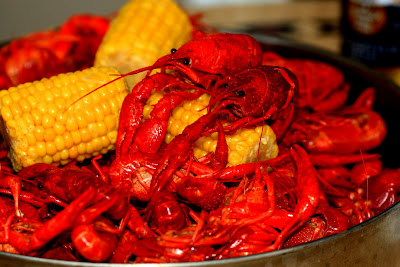
Boiled Crawfish

Boiled CrawfishWhen you smell boiled crawfish around your neighborhood in Louisiana, you know spring arrives. The season of Louisiana crawfish is from early spring to early summer. The best crawfish boil is done at home using a big pot with Cajun spices, potatoes, onions, corns, garlic and other vegetables and eat with many friends and family. This is one of the typical Cajun dishes. Do not hesitate to use your fingers to get dirty because this also brings the dynamic sprit of Cajun culture. Actually, it is impossible to eat crawfish without using your fingers!

Acadians, as the Cajun ancestors are known, originally came from France. In the early 1600’s, Acadians moved to settle Nova Scotia, New Brunswick and Prince Edward Island in Canada when France established its colonies there. However, after British took over the colonies from France, in 1755 many of the Acadians were brutally deported. According to Wikipedia, more than 12,000 Acadians were expelled from Canada between 1755 and 1763.

Eventually, many of the Acadians escaped to Louisiana where France had colonized. First, they arrived to New Orleans, which was already occupied by other immigrants. As a result, they were forced out further southwest of New Orleans, which were undesirable swamp areas. They had to live in horrible conditions in which the summer was terribly hot and humid and malaria and yellow fever were constantly present.

Living in an unwanted swamp region was challenging. However, this circumstance gave plenty of “spices” into the distinctive Cajun cuisine.

Crawfish has been used for just bait for a long time. They had been considered as smelly and ugly creatures. However, throughout the tough life living in swamps, Cajuns discovered their unique taste and turned them into an exquisite Cajun dish. Adding Cajun spices, vegetables and, sometimes, Cajun sausages brings out the fine flavor of crawfish in an excellent way.

Boiled Crawfish
Once a year, my husband and I decided to eat boiled crawfish to celebrate whatever we wish. This spring, we celebrated my fist spring in Louisiana and have a high regard for Cajuns who amazingly survived, thrived in this region and developed their own unique culture.

Saturday, May 30, 2009

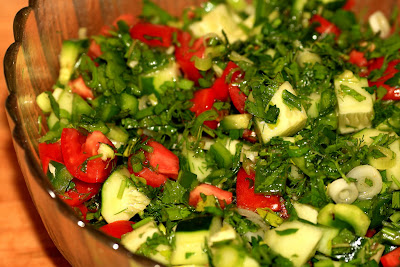
Çoban Salata

Çoban SalataWhen Erika, one of my girlfriends, was dating with an Arabic boyfriend, she took me to a Turkish restaurant in Boston. I was very excited because it was the first time for me to taste Turkish food.
“Let’s start with Turkish salad and rice. They are really good, “ she said.
So we started with Çoban (pronounced “tso-ban”) Salata and pilaf. They were supposed to be appetizers. However, after we finished them, we decided to order the same dishes, again. I just fell in love with this simple yet delicious salad. The salad simply consists of tomatoes, cucumbers, onions and parsley. But there was some particular spice I could not figure out at that time.

Turkish food is famous for various kinds of spices. That was why I believed the salad had some special spices until just a few weeks ago when I took the first Turkish cooking class. Unexpectedly, the menu was Çoban Salata, pilaf and two other dishes. I was thrilled. Then I found out that the secret of the delicious flavor was a popular herb, mint.

Mint is very easy to cultivate. In my garden, mint grows like weeds and out of control. It had never crossed my mind that this herb gives such a precious flavor.

By the way, Erika is still a beautiful and joyful bachelorette living in Boston. Her current boyfriend is Italian. So she takes me to Italian restaurants in Italian District whenever I visit her. She introduced me to numerous kinds of good food. I admire her excellent choice of food and, of course, her patient and generous men.

Ingredients:
4 tomatoes
2 cucumbers
1 green pepper
1 cup chopped green onions
¼ cup finely chopped flat leaf parsley
¼ cup finely chopped mint
3 tbsp chopped dill
Extra virgin olive oil
2 lemons
Salt
Optional: Feta cheese

Directions:
1. Dice the tomatoes, cucumber and green pepper. Place them in a large salad bowl.
2. Add the chopped green onions, parsley, mint and dill. Pour the olive oil and sprinkle lemon juice. Stir them well.
3. Add salt and stir right before you serve. Serving with feta cheese is optional but it is good.

Wednesday, May 27, 2009

Green Beans with Tomato Sauce (Fasolakia)

One thing that extremely surprised me about my husband’s cooking is the use of lots of olive oil. His olive oil consumption is about 500ml per week. This is equivalent to mine for a few months.
“It has to be Greek, cold pressed, extra virgin olive oil,” my husband, whose native country is Greece, said and poured plenty of olive oil on meat, fish, vegetables, breads and even many of the Japanese dishes I make.

Fasolakia (or baby green beans in English) is one of the typical Greek summer dishes and requires lots of olive oil. Usually, I try to use less olive oil than my husband wishes. But for this dish, I do not hesitate to use tons of olive oil. Green beans match with tomato sauce and olive oil flavor very well.

Although green beans are a very popular summer vegetable in Japan, I did not know they are very nutritious food. Green beans are an excellent source of vitamin K, which prevents blood clotting, osteoporosis and oxidative cell damage. They are low in calories and very healthy food.
Fasolakia is usually served with feta cheese or anchovies. If you would like to try in a Greek way, cut down the salt in this dish and enjoy it with salty anchovies or feta cheese!
Ingredients:
1 lb green beans
1 chopped onion
2-3 cloves of garlic
3 cups chopped ripe tomatoes
2 tbsp tomato paste
1/2 cup extra virgin olive oil
1 bay leaf
Salt and freshly ground black pepper
Optional: 3-4 chopped potatoes

Directions:
1. Wash the green beans well. Cut off both ends. If they are too long, cut them half. If they have strings on the sides, remove the strings.
2. Heat 3tbsp of olive oil and the garlic in a large pot. Add the chopped onion and fry them until they become transparent. Add the tomatoes, tomato paste and bay leaf. Add the green beans and the chopped potatoes (optional). Season the mixture with salt and black pepper and simmer for about 30 to 40 minutes until the green beans become soft.
3. Add the 1/2 cup of extra virgin olive oil and simmer for 3 to 5 minutes. Serve this with feta cheese!

Friday, May 15, 2009

Burdock Kinpira (Kinpira Gobo)

Burdock Kinpira
Kinpira is a traditional Japanese side dish, in which small striped vegetables are fried with sweet soy sauce. Burdock kinpira is the most well known among all kinpira dishes. People started eating burdock roots about 300 years ago and at the same time kinpira became a typical home made dish. It was named after Kinpira whose father was Kintaro. Kintaro lived more than one thousand years ago and is famous from many children fair tales because of his supernatural capabilities. Since burdock is very healthy and believed to be an excellent source of energy, people named this dish after Kinpira.

Roots of young burdock are one of the most popular root vegetables in Japan. In China dried burdock roots have been used as an anti-fever and cough remedy for centuries. This vegetable is an excellent source of dietary fiber, zinc, potassium and vitamins B1 and B2. It helps to clean the stomach and intestines and to avoid constipation. Also it is high in inulin (a type of naturally occurring sugar in some plants not to be confused with insulin which is a hormone that affects metabolism), which can help to manage diabetes. However, in most of the European countries, they are treated just as weeds.

Sadly, I have not seen burdock roots in any regular grocery store here in Louisiana except in some Asian stores. Even thought I can find them in one local Asian store, most of the time, I always question the freshness of the vegetable.

The other day, I found some nice looking burdock roots at one of the Asian markets in my place. My friend, who is a nutritionist from Japan, suggested that they were fresh enough. Thus, I purchased one bag of burdock roots, nearly 2 lb, and decided to cook burdock kinpira.

Although burdock roots were not as fresh as I wanted, I really enjoyed burdock kinpira. I do not remember when I had kinpira for the last time. When I was in Japan, this dish was a common one on our family’s dinner table or in a lunch box. It reminds me of my mother’s cooking. I truly wish that people can appreciate the benefits of eating burdock roots and in the near future this vegetable would be available in many stores.

Using burdock roots and carrots is a typical combination. However, adding chicken, pork, or green beans can be more nutritious and also may become the main dish. Serve with rice!


Ingredients:
1 lb burdock
2 carrots
1 red pepper
2 teaspoon roasted sesame (both white and black sesame are fine.)
3 tbsp sesame oil (any oil for frying is fine.)

Ingredients for sweet soy sauce:
3 tbsp soy sauce
1 tbsp sake
2 tbsp mirin
1 tbsp sugar

Directions:
Scrape off the skin of the burdocks. Do not peel off since the skin has a lot of flavor.
Cut into 1.5 inch-long small sticks. Put them in a bowl and add water until all the burdock sticks are covered. Add 1 tbsp of rice vinegar. Leave them for about 10 minutes in order to remove their natural harshness.
Peel the skin of the carrots and cut them into small sticks of the same size as the burdock sticks.
Slice off the stalk and remove the seeds of the red pepper. Cut into small rings.
Heat the sesame oil in a pot. Drain the burdock sticks well. Fry them along with the carrot sticks for 2-3 minutes. Add the ingredients for sweet sauce and the red pepper. Continuously fry for another 5 munities until all the sauce is gone.
Transfer to serving plates. Sprinkle them with the roasted sesame before serving.

Tuesday, May 12, 2009

Grilled Blue Fish

Grilled Blue FishA “Buy One, Get One Free!” advertisement always reminds me of a grilled fish in my family. When I cook a grilled fish, I usually make Greek version and Japanese version at the same time, which makes me feel that I get an extra for free!

Grilled fish is one of the very basic dishes in both Japan and Greece. Every time I visit Greece and order a freshly grilled fish, I always regret for not bringing with me a bottle of soy sauce. When we are in Japan, my husband always asks me for olive oil and lemon juice on front of a juicy grilled fish.

Therefore, when we cook grilled fish at home, we make a friendly decision for each other. We grill a fish and add different flavors for each other. Olive oil and lemon juice are necessary in Greek cuisine. Seasoning a fish with a lot of oregano and sprinkling olive oil and lemon juice makes the grilled fish authentic Greek / Mediterranean cuisine. Concurrently, soy sauce and sake (or mirin) are essential in preparing most Japanese dishes. Adding spicy ground daikon and ponzu or soy sauce on a grilled fish creates a perfect Japanese dish. Try both ways and decide which one you like!

Japanese Grilled Blue FishFor the Japanese version
Ingredients:
3lb of a whole blue fish
Salt
Sake
½ cup freshly ground daikon (Asian white radish)
Ponzu sauce (or soy sauce)
§ 1cup soy sauce
§ ½ cup lime juice
§ ½ cup rice vinegar
§ 3 tbsp mirin
§ 5 tbsp dried bonito flakes
Mix them and leave the mixture overnight or for a few days. Strain.

Directions:
1. Remove the guts, gills and scales of the blue fish. Wash it well and wipe water around the surface. Spray sake or brush sake on the fish.
2. Sprinkle with olive oil and lemon juice. Season the blue fish with a lot of salt both sides.
3. Prepare charcoal for barbeque.
4. Grill the fish until the fish is done.
5. Transfer them to a serving plate.
6. Drain the ground daikon. Place it on the serving plate. Pour 3-5 tbsp of ponzu or soy sauce.

Greek Grilled Blue FishFor the Greek version
Ingredients:

3lb of a whole blue fish
Salt and freshly ground black pepper
Extra virgin olive oil
Oregano
Lemon juice

Directions:
1. Remove the guts, gills and scales of the blue fish. Wash it well and wipe water around the surface.
2. Sprinkle with olive oil and lemon juice. Season the blue fish with the salt, black pepper and oregano both sides.
3. Prepare charcoal for barbeque.
4. Grill the fish until the fish is done.
5. Transfer them to a serving plate. Sprinkle the fish with olive oil and lemon juice. Serve with yogurt dip!

Monday, May 11, 2009

Meat Balls (Keftedes)

KeftedesAfter I watched the 2003 Greek movie, Politiki Kouzina (Istanbul Cuisine as it is directly translated in English or A Touch of Spice as it better known internationally) my Greek meatballs became spicier.

This is a story about a Greek boy who was born in Istanbul, Turkey. His grandfather had a small store selling spices in Istanbul and giving lessons to the little boy about not only spices and cooking but also about life and faith. When a political conflict between Greece and Turkey erupted, his family along with many other Greek families were deported from their hometown of Istanbul with just a few belongings. However, his grandfather was left behind. His family escaped to Athens, Greece, yet they were not fully embraced by their own people in Greece. After more than three decades, the boy, later became a world renowned astronomer, went back to see his dying grandfather for the first time since his family had left Istanbul. Throughout of this journey, he realized there was a touch of an important spice missing in his life.

In this beautiful movie, there was a scene in which the grandfather gave this little boy a tip of how to make delicious meatballs. Adding a little bit of cumin and cinnamon gives them incredible flavor. Right after I watched the movie, I tried to cook Greek meatballs and followed the grandfather’s tip. It came out excellent! I loved it and since then my Greek meatballs cannot be done without these hidden flavors.

The traditional Greek meatballs are usually fried coated with flour. However, this time I baked them in the oven, which made my life much easier. These meatballs can be served as an appetizer or part of a sandwich.

KeftedesGreek meatballs Recipe
Ingredients (about 20 to 25 meatballs):
1 lb ground beef
½ cup panko (bread crumbs)
1 finely chopped onion
2 cloves of garlic
¼ cup finely chopped flat leaf sparsely
¼ cup finely chopped mint
2 tbsp extra virgin olive oil plus 3 tbsp olive oil for frying the onion and the garlic
1 egg
½ cup red wine
1 teaspoon salt
Freshly ground black pepper
A pinch of cumin and cinnamon
Lemon juice

KeftedesDirections:
1. Heat 3tbsp of olive oil and the garlic in a large pot and fry the chopped onion until the onion becomes transparent.
2. Preheat the oven to 360 F degrees.
3. Place the onion and garlic with the rest of the ingredients in a big bowl. Mix them well. Leave the mixture for 10-15 minutes in room temperature.
4. Break off pieces of the mixture and make small meat balls and place them on an oven pan.
5. Bake them for 25-30 minutes. Transfer them to a serving plate. Sprinkle them with lemon juice. Enjoy them!

Saturday, May 9, 2009

BBQ Pork Loin Ribs (Like Paidakia)

Pork Ribs with French Fries“It tastes like paidakia,” my husband said.
Paidakia means “little kid ribs” in Greek. When my husband and I went to Greece for the first time, Stelios, my husband’s childhood friend, took us to a local restaurant in Marathon City (yes, this is the place where the first Marathon run took place, almost 2,500 years ago) where we had delicious paidakia. The barbecue pork loin ribs we had last week was the closest taste to the paidakia we could get in the US. They were as tender and juicy as paidakia.

I got these pork ribs from Target. I paid $6.16 for 4 chops with a $3 coupon. So it was $3.16, which was a great deal!

The real reason I went to Target was to buy meat for our cat. When one of our beloved cats died of cancer a few years ago and one woman told us that she cooked for her healthy 18-year-old cat, my husband and I decided to cook for our surviving cat. At that time, the news about toxic dog/cat food became a big issue. That incident also made us think that cooking for our cat might help him be healthy. We have bought chicken, pork, beef and catfish meats from a regular super market and baked them to feed our cat. As a result of this, our cat, which used to be obese and weighted more than 20 lb, lost lots of extra weight and now he is a healthy 13.5 lb. He is healthier than ever. He is now 14 years old but he is much more active than ever before.

Eating homemade food may help him to be fit and active. Buying meat and fish and cooking for a cat is a little bit pricier than just buying cat food. Yet, thinking of taking him to a hospital due to his overweight problem and other related problems, we simply believe this is a much cheaper and wiser option. I believe this healthy diet can apply to humans. Buying good food supplies and then cook at home may cost and take you some extra time but eventually it would pay off. You may be able to save a lot of money by not having serious health problems.

Eating good food does not mean eating expensive food. Cooking and eating $3.16 for 4 pork chops was a fantastic experience. Moreover it reminded me of that beautiful summer night in Greece.

BBQ Pork Loin Ribs Recipe

Ingredients:
4 pieces of pork loin ribs
½ cup red wine
1/8 cup extra virgin olive oil
1 clove of sliced garlic
Oregano, salt and freshly ground black pepper
Lemon juice

Directions:
1. Make some incisions in the meat and insert the sliced garlic in the pork ribs.
2. Place the pork ribs in a flat dish. Sprinkle the wine, ¼ cup of olive oil and 2-3 tbsps lemon juice. Turn to coat well. Season them with salt, pepper and plenty of oregano. Marinate them for about 15-20 minutes.
3. Meanwhile, prepare charcoal for barbecue.
4. Grill the pork ribs until they are well done. Then, transfer them to a serving plate and sprinkle them with lemon juice. Serve with French fries and salad!